Also Human by Caroline Elton
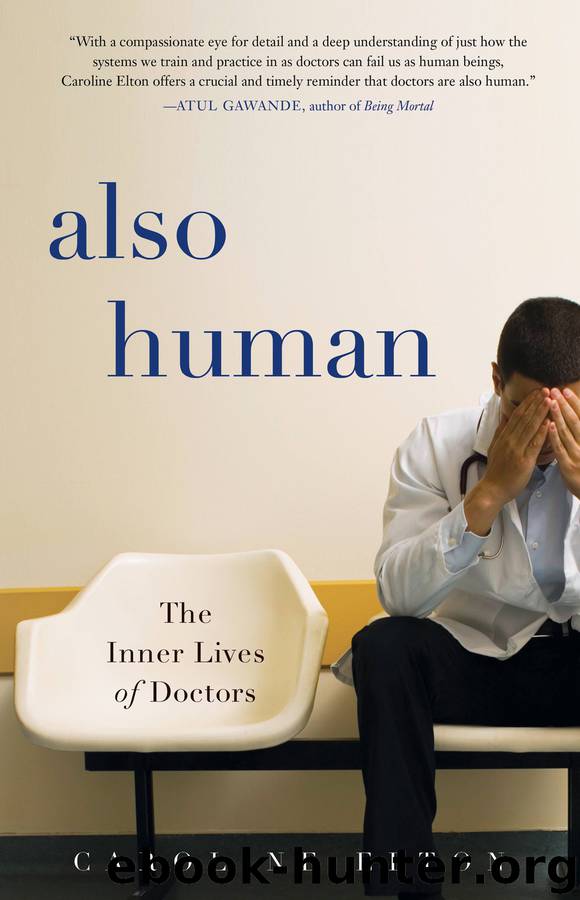
Author:Caroline Elton
Language: eng
Format: epub
Publisher: Basic Books
Published: 2018-06-11T16:00:00+00:00
As many female doctors choose general practice because of the flexibility it offers, women are overrepresented among GPs and underrepresented among hospital consultants. Two hospital specialties, however, buck this trend and have a majority of female consultants. Just two. Not surprisingly these two specialties are obstetrics/gynecology and pediatrics; women doctors flourish as long as they are dealing with “womanly” problems such as pregnancy, childbirth, and children.
And the hospital specialty with the lowest proportion of female consultants? Surgery. In 2016 just 12 percent of surgical consultants were women. This difference can’t be explained away in terms of women not being interested in or good at surgical procedures, as obstetrics/gynecology could technically be defined as a surgical specialty. And with acute obstetrics, unlike every other surgical specialty, the surgeon has to safeguard the well-being of two patients (mother and baby) rather than just one. Yet in the UK, the proportion of female consultants in obstetrics/gynecology is over four times greater (51 percent) than the proportion of female consultants in other surgical specialties.
Women doctors don’t only cluster in different specialties; they are also much more likely to work part-time. So for example, a 2016 survey of over ten thousand doctors in the UK found that while 42 percent of women worked part-time, the comparable figure among men was 7 percent. The proportion of part-time medics was also skewed by specialty; among female GPs, 40 percent worked part-time while among female surgeons, the figure was 10 percent. Women in surgical specialties are still very much in the minority—and when they do choose these specialties, they are highly unlikely to work part-time. This study also showed clearly that the critical factor was children. In fact, female doctors without children were no more likely to work part-time than male doctors with, or without, children.
Family considerations also impact on the proportion of female doctors choosing to go down an academic clinical pathway. Doctors who choose this type of career have to complete the same demanding clinical training but on top of this have to carry out research, write academic papers, and complete complex applications for continued research funding. Given that doctors in the US have clinical schedules of eighty hours per week, it’s clear why opting for a chunky additional set of tasks might put women off—particularly if they go home to equally chunky domestic responsibilities. Even in the UK, where working hours are constrained by the European Working Time Directive and integrated academic training pathways have been devised, a significant gender imbalance remains in academic medicine—particularly at senior levels.
As in so many other professions, women doctors are also paid less than their male counterparts. In part this discrepancy is due to the fact that across the consultant workforce as a whole, women consultants tend to be younger, are more likely to have had career breaks, and are less likely to hold high-profile administrative or research posts. These factors account for about 60 percent of the pay gap between male and female consultants. The remaining 40 percent is caused by the fact that women get different financial rewards for the same achievements.
Download
This site does not store any files on its server. We only index and link to content provided by other sites. Please contact the content providers to delete copyright contents if any and email us, we'll remove relevant links or contents immediately.
| Administration & Medicine Economics | Allied Health Professions |
| Basic Sciences | Dentistry |
| History | Medical Informatics |
| Medicine | Nursing |
| Pharmacology | Psychology |
| Research | Veterinary Medicine |
Periodization Training for Sports by Tudor Bompa(8285)
Why We Sleep: Unlocking the Power of Sleep and Dreams by Matthew Walker(6732)
Paper Towns by Green John(5201)
The Immortal Life of Henrietta Lacks by Rebecca Skloot(4597)
The Sports Rules Book by Human Kinetics(4406)
Dynamic Alignment Through Imagery by Eric Franklin(4225)
ACSM's Complete Guide to Fitness & Health by ACSM(4066)
Kaplan MCAT Organic Chemistry Review: Created for MCAT 2015 (Kaplan Test Prep) by Kaplan(4021)
Livewired by David Eagleman(3782)
Introduction to Kinesiology by Shirl J. Hoffman(3781)
The Death of the Heart by Elizabeth Bowen(3630)
The River of Consciousness by Oliver Sacks(3609)
Alchemy and Alchemists by C. J. S. Thompson(3528)
Bad Pharma by Ben Goldacre(3433)
Descartes' Error by Antonio Damasio(3286)
The Emperor of All Maladies: A Biography of Cancer by Siddhartha Mukherjee(3172)
The Gene: An Intimate History by Siddhartha Mukherjee(3101)
The Fate of Rome: Climate, Disease, and the End of an Empire (The Princeton History of the Ancient World) by Kyle Harper(3071)
Kaplan MCAT Behavioral Sciences Review: Created for MCAT 2015 (Kaplan Test Prep) by Kaplan(2991)
